
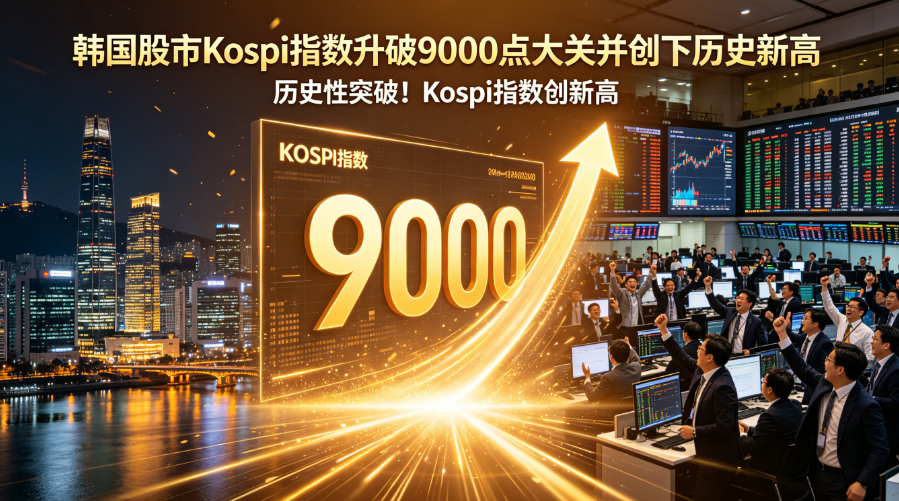
摘要: 2025年5月韓國Kospi指數受芯片巨頭帶動創歷史新高,但外資與本土機構同步淨賣出,散戶孤軍奮戰;Kosdaq重挫超3%。美伊臨時和平協議使油價走低,文章剖析芯片產業動能、資金流向及地緣政治影響,探討繁榮表象下的脆弱性與風險。
Structural Contradictions Behind South Korea’s Record Stock Rally: Coexistence of Booming Chip Stocks and Capital Outflows
Introduction
In May 2025, South Korea’s stock market hit a historic milestone: buoyed by leading chip giants, the KOSPI Index surged as much as 1.5% to set an all-time high. Yet beneath this seemingly universally optimistic market performance lie profound structural contradictions. Foreign investors and domestic institutional funds recorded simultaneous net sell-offs, leaving retail investors to prop up the market alone. While the main board rallied wildly, the KOSDAQ—dominated by growth-oriented small-cap firms—plunged more than 3%. Meanwhile, international crude oil prices fell following the signing of a temporary peace accord between the U.S. and Iran, introducing new variables to global inflation expectations and monetary policy trajectories. Centered on these developments, this paper delivers an in-depth analysis across multiple dimensions including momentum in the semiconductor sector, capital flow patterns, and geopolitical spillover effects, exploring vulnerabilities and latent risks beneath the surface prosperity of South Korea’s equity market.
The Two Chip Titans Reignite Market Enthusiasm
The semiconductor sector served as the most immediate driver behind this record-breaking rally for South Korea’s stock market. SK Hynix jumped as much as 5.9% intraday, while Samsung Electronics rose 2.5%, jointly forming the strongest pillar supporting the KOSPI Index. This upturn stems from explosive, sustained global demand for High Bandwidth Memory (HBM) and advanced logic chips fueled by artificial intelligence (AI) and High-Performance Computing (HPC). Since the AI industry accelerated its expansion in 2023, SK Hynix has leveraged its technological edge in HBM3E products to secure nearly exclusive supply orders from key clients such as NVIDIA, consistently beating earnings forecasts. While Samsung Electronics races to narrow its HBM technology gap, its long-term layout in foundry operations and cyclical recovery in memory chip prices have driven simultaneous improvements in revenue and profit margins.
Nevertheless, the stellar performance of chip stocks carries underlying risks. Despite robust short-term demand, a sharp surge in global semiconductor capital expenditure risks triggering oversupply after 2026. Additionally, U.S. export controls on chips to China keep tightening. As a U.S. ally, South Korean corporations are caught in an increasingly delicate position amid the U.S.-China tech rivalry. An escalation in geopolitical frictions or a slowdown in AI-related order growth could trigger a drastic correction in South Korea’s chip equities. Investors must closely monitor upcoming quarterly inventory turnover days and gross margin figures released by SK Hynix and Samsung Electronics to gauge whether the industry cycle is nearing its peak.
Capital Flows Expose Market Fragility: Simultaneous Retreat by Foreign and Institutional Investors
Although the KOSPI Index notched a historic high, capital flow data sent unsettling signals. Overseas funds and domestic institutional investors logged net sales of KOSPI constituent stocks on the trading day, with only retail investors buying against the market trend. In financial markets, this pattern is widely viewed as a classic sign of “retail euphoria while smart money exits.”
Foreign capital flight is closely tied to shifting expectations around the global interest rate landscape. The U.S.-Iran temporary peace accord pulled oil prices lower, which partially eased imported inflation pressures and lifted market bets on Federal Reserve rate cuts. However, South Korea’s central bank still faces severe domestic price pressures and household debt issues, with risks of South Korean won depreciation unresolved. Foreign investors hold large positions in South Korean equities and tend to lock in profits when they project a renewed widening of the U.S.-Korea interest rate spread or judge that domestic economic momentum cannot sustain lofty valuations. Domestic institutional selling largely reflects caution over domestic liquidity conditions: structural adjustments in South Korea’s real estate market remain incomplete, bank credit growth is slowing, and institutional investors must maintain cash buffers to meet redemption demands.
Sustained buying by retail investors partly mirrors their optimistic outlook for a long-term bull market, yet it may also stem from FOMO (fear of missing out). Historical experience repeatedly proves that when retail investors become the sole bullish force, markets typically hover near cyclical peaks. If chip stocks see profit-taking afterward, the index, lacking institutional backing, will face substantial downside risks.
KOSDAQ’s Sharp Plunge: Deflating Valuation Bubbles for Growth Stocks
In stark contrast to the KOSPI’s strength, the KOSDAQ Index—focused on small-caps and tech growth names—slumped as much as 3.1%. This divergence reveals a “risk-off rotation” of capital shifting away from high-risk assets toward blue-chip stocks. Many KOSDAQ-listed firms lack stable profitability, with their valuations heavily reliant on market sentiment and abundant liquidity. Recently, domestic risk-free interest rates in South Korea have swung more violently amid monetary policy uncertainty. Coupled with broad valuation pressure on global growth stocks, the KOSDAQ has borne the brunt of capital outflows.
Furthermore, a considerable share of KOSDAQ-listed companies operate in cutting-edge sectors including biotechnology and new energy. These industries feature lengthy technology commercialization cycles and high exposure to shifts in global trade policies. While the U.S.-Iran peace accord stabilizes oil prices, de-escalation in Middle Eastern geopolitics may dampen global urgency for alternative energy sources, weighing on South Korean photovoltaic and hydrogen-related concept stocks. The KOSDAQ slump represents not merely a correction of inflated valuations, but a recalibration of pricing for future industrial trends.
The U.S.-Iran Accord and Crude Oil: Short-Term Inflation Relief vs. Long-Term Uncertainties
International oil prices dropped immediately after the U.S. and Iran signed a temporary peace accord. The economic impact on South Korea can be analyzed on two tiers. In the short run, lower oil prices directly cut South Korea’s import costs, ease trade deficit pressures, and grant the central bank greater policy leeway to manage consumer prices. As one of the world’s major crude importers, South Korea will see improved corporate profit margins from falling energy expenses, particularly benefiting petrochemical, airline and transportation sectors.
Long-term stability in the Middle East, however, remains highly uncertain. Key unresolved risks linger: whether the temporary peace accord can evolve into a permanent settlement, potential military confrontation between Israel and Iran, and U.S. domestic political sentiment toward the agreement. A breakdown of the accord would send oil prices rebounding sharply, subjecting South Korea to the dual blows of imported inflation and slower economic growth once again. Persistently subdued oil prices may also reduce willingness among Middle Eastern sovereign wealth funds to invest in South Korean assets, triggering negative spillover effects on foreign capital inflows.
Conclusion: Clear-Headed Assessment Behind Market Prosperity
South Korea’s stock market hitting an all-time high is undoubtedly a combined outcome of the semiconductor sector’s global competitiveness and cross-border capital flows. Yet this milestone is accompanied by numerous structural hidden risks. Simultaneous outflows by foreign and institutional investors, a deep correction in the small-cap market, and latent geopolitical risks all remind investors that market optimism is overly reliant on gains from a handful of heavyweight stocks, without solid support from overall economic fundamentals and liquidity conditions. For South Korean regulators, heightened vigilance is now required against the buildup of asset price bubbles and systemic financial risks. Policymakers must strike a balance between sustaining industrial competitiveness and preventing market overheating, while accelerating economic structural diversification to reduce excessive reliance on the single semiconductor industry. For investors, record highs bring both opportunities and traps. Only by looking past surface gains to scrutinize capital flows and macro risks can investors retain rationality amid volatility and safeguard long-term returns.

